Basement Flooding in Brookhaven: Sump Pumps & Red Clay Drainage
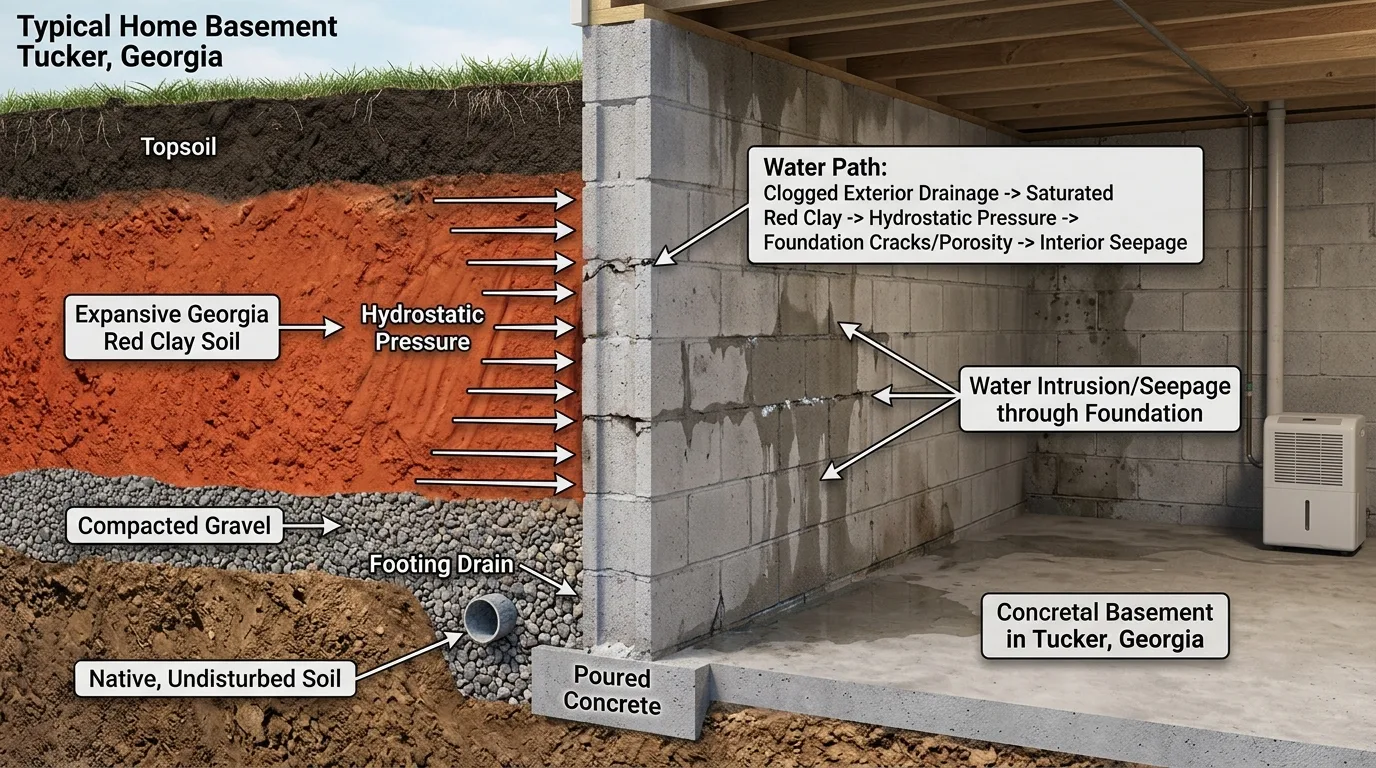
By late spring, the pattern is predictable in certain Brookhaven neighborhoods: a major rain event, and within 24 hours, homeowners in lower-lying areas near Peachtree Creek and throughout the Drew Valley and Brookhaven Village districts are reporting water in their basements. Some of these are one-time events. Many are recurring — the same basement, the same entry point, every wet season.
Recurring basement flooding in Brookhaven is almost always a drainage problem. And drainage problems in DeKalb County almost always involve Georgia red clay soil. Understanding how clay soil creates hydraulic pressure against foundations — and what engineering solutions interrupt that pressure — is the foundation for making informed decisions about sump pump systems, interior drainage, and exterior waterproofing for your Brookhaven home.
In this post, we cover the mechanics of red clay basement flooding, sump pump system options, interior drainage design, and what professional flood cleanup involves when prevention wasn’t in place.
Basement Flooded in Brookhaven? Call Us Now
24/7 emergency basement water extraction and drying throughout DeKalb County. Call (877) 698-1311.
How Georgia Red Clay Soil Causes Basement Flooding in Brookhaven
Basement flooding in Brookhaven originates from one of three pathways, all of which are amplified by red clay soil:
Hydrostatic pressure: When Georgia red clay soil surrounding a basement becomes saturated — as it does during heavy spring rains or extended wet periods — it exerts hydraulic pressure against basement walls. Water under pressure finds paths of least resistance: mortar joints in block foundations, cracks in poured concrete, floor-wall joints, and tie holes left from formwork. Even basements with no obvious cracks experience seepage through the inherent porosity of block walls when hydrostatic pressure builds.
Surface drainage: Red clay’s poor permeability means that rainwater falling faster than it can infiltrate the soil flows as sheet runoff across the surface. This runoff follows low points toward structures, pooling against foundation walls and entering through window wells, exterior door thresholds, and above-grade openings. In Brookhaven’s topographically diverse neighborhoods, properties at the base of slopes receive surface runoff from uphill lots in addition to direct rainfall.
Groundwater rise: Extended wet periods — including Brookhaven’s multi-day rain events common in winter and spring — raise the local water table, bringing groundwater up against basement floor slabs from below. This uplift pressure is distinct from wall seepage: water enters through floor cracks and floor-wall joints rather than through walls.
Why Sump Pumps Are Essential for Many Brookhaven Basements
A sump pump system is the most common and cost-effective solution for recurring basement flooding in Brookhaven’s clay soil conditions. The system works by creating a collection point (the sump pit) at the lowest point of the basement floor where water that enters naturally accumulates. A submersible pump in the pit activates automatically when water reaches a float trigger, discharging water away from the foundation through a discharge line.
Primary sump pump options:
Submersible pumps: Installed inside the sump pit, submersible pumps are quieter than pedestal pumps and can handle debris-laden water. For Brookhaven basements with regular flooding events, 1/3 to 1/2 HP submersible pumps handle typical residential flows. Heavy flooding scenarios near Peachtree Creek warrant 3/4 to 1 HP units.
Pedestal pumps: Motor mounted above the pit on a vertical shaft. Less expensive than submersible models and easier to service, but louder during operation and less suited to large water volumes.
Battery backup systems: This is the critical component that many Brookhaven homeowners neglect until a power outage disables their primary pump during the storm that’s causing the flooding. Sump pump systems without battery backup are vulnerable precisely when they’re needed most — during the power outages that often accompany Brookhaven’s summer thunderstorms. A battery backup unit activates automatically when the primary pump loses power, providing several hours of continued pumping capacity.
Combination systems: Primary submersible pump with integrated battery backup in the same unit — the preferred configuration for Brookhaven basements with regular flooding events.
Sump Pump Failure Flooded Your Brookhaven Basement?
Fast extraction and drying for sump pump failure events throughout DeKalb County. Call (877) 698-1311 — available 24/7.
Interior Drainage Systems for Chronic Basement Flooding
For basements where hydrostatic wall seepage is the primary flooding mechanism — rather than surface runoff or groundwater uplift — interior drainage systems address the issue by channeling water that enters through walls to the sump pit before it reaches the floor.
Interior drain tile systems installed along the interior footing — below the floor slab — capture water migrating through basement walls and route it to the sump pit by gravity. Installation involves breaking the concrete floor along the perimeter, excavating a trench, installing perforated drain pipe in washed gravel, and replacing the concrete floor. While disruptive to install, interior drain tile systems are highly effective and have a long service life in Brookhaven’s clay soil environment.
Wall channel systems — dimple mats or drainage board applied to the interior of basement walls above the floor-wall joint — direct wall seepage to a floor channel rather than allowing it to spread across the floor. These systems are less disruptive to install than subfloor drain tile but less effective for significant water volumes.
When to Call Professional Flood Cleanup Instead of Just Installing a Pump
Sump pump systems and interior drainage are prevention measures — they’re appropriate for homes where basement flooding is a recurring risk that hasn’t yet caused significant damage. When flooding has already occurred in a Brookhaven basement, the water damage must be professionally remediated before prevention systems are installed:
Wet insulation, saturated drywall, water-logged floor joists, and standing water on concrete floors all require professional extraction and drying before the basement can be assessed for waterproofing upgrades. Installing a sump pump in a basement with active mold growth or wet framing doesn’t address the existing damage — it only positions the space better for the future.
Water damage restoration for basement flooding events follows the same process as other water events: extraction, moisture mapping, material removal where needed, structural drying with commercial equipment, antimicrobial treatment, and clearance documentation. Basement events often involve gray or black water (storm flooding, sewer backup) that require biohazard protocols in addition to standard drying.
Practical Steps for Brookhaven Homeowners with Basement Flooding Risk
- Install a sump pump with battery backup before the next flooding season if your Brookhaven basement has flooded more than once.
- Grade soil away from the foundation: Ensure the ground slopes away from your home at a minimum of 6 inches in the first 10 feet around the perimeter.
- Extend downspouts: Downspout discharge should extend at least 4–6 feet from the foundation — not into the adjacent soil against the house.
- Test your sump pump quarterly: Pour water into the pit and confirm the pump activates and the discharge line is clear.
- Consider a floor drain: Properly installed and maintained floor drains in Brookhaven basements provide a controlled water exit during minor seepage events, reducing the volume reaching the sump before the pump activates.
Frequently Asked Questions
How much does a basement sump pump system cost in Brookhaven?
A basic sump pump installation — pit excavation, submersible pump, and discharge line — runs $800–$1,500 installed in Brookhaven. Adding a battery backup unit adds $300–$700. Full interior drain tile installation in a 500–1,000 sq ft Brookhaven basement runs $4,000–$8,000. These costs should be evaluated against recurring flood damage restoration costs, which typically range $3,000–$15,000 per event depending on water depth and category.
Does a sump pump eliminate all basement flooding risk in Brookhaven?
A properly sized and maintained sump pump with battery backup eliminates most routine flooding risk from groundwater and minor seepage events. However, extreme flooding events — major Peachtree Creek overflow, simultaneous failure of discharge line and battery backup, or flooding volumes exceeding pump capacity — can still cause basement flooding even with a functional sump system. Interior drainage systems combined with exterior grading improvements provide the most robust protection for Brookhaven basements in high-risk zones.
My basement flooded for the first time — do I need a sump pump, water damage restoration, or both?
You need water damage restoration first, then sump pump evaluation. The immediate priority is extracting standing water, drying structural materials, and preventing mold growth — tasks that must occur regardless of what waterproofing upgrades follow. After the space is dry and restored, a waterproofing assessment can determine what prevention measures are appropriate for your specific flooding pathway and risk level.
Brookhaven Basement Flooding — Professional Cleanup and Prevention Guidance
Emergency extraction, drying, and honest waterproofing advice. Call Brookhaven Water Damage Restoration at (877) 698-1311.
Related: