Mold After Water Damage: Brookhaven's Humidity Problem
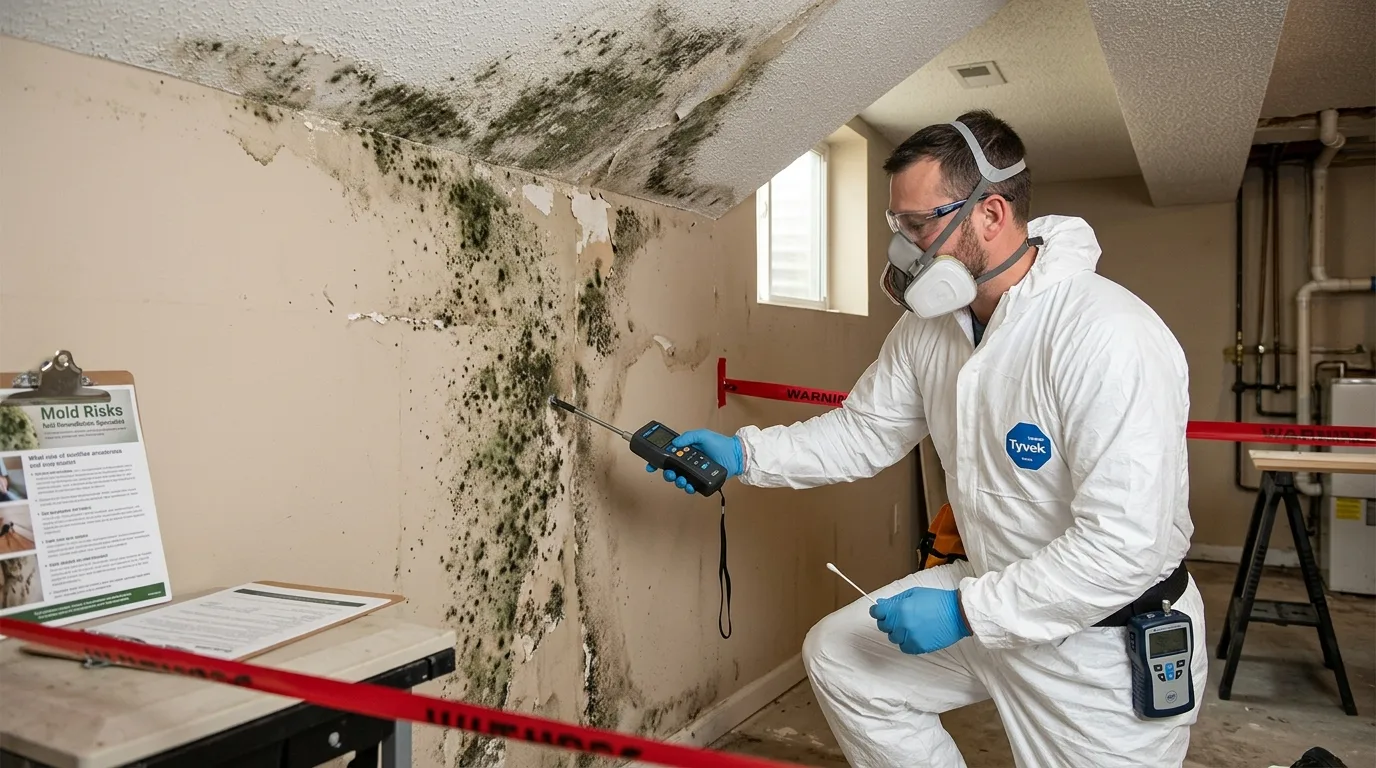
Ask any water damage restoration professional in Brookhaven how often mold follows untreated water damage, and the answer will be close to “always.” Georgia’s summer humidity — with outdoor relative humidity regularly exceeding 70% from June through August — creates conditions where mold development after water damage isn’t a possibility to guard against. It’s a near-certainty unless professional drying intervention occurs within the first 24–48 hours.
In this post, we cover the mold development timeline specific to Brookhaven’s climate, the health impacts of mold exposure, what professional mold remediation involves, and the dehumidification standards that determine whether drying actually prevents mold or merely delays it.
Mold After Water Damage in Brookhaven? Act Now
IICRC certified mold remediation serving Brookhaven and all of DeKalb County. Call (877) 698-1311.
Why Brookhaven’s Humidity Makes Mold Near-Inevitable After Water Damage
Standard water damage guidance states that mold can begin developing within 24–48 hours of water exposure. In Brookhaven’s climate, this timeline compresses during the hottest months.
Mold requires three conditions to grow: organic material (wood, paper, drywall facing), moisture, and a temperature range that supports biological activity. In Brookhaven’s June through August climate — with average highs reaching 85–89°F and relative humidity regularly above 70% — the ambient conditions provide two of the three requirements continuously. The moment a water event introduces moisture to structural materials, all three mold growth requirements are met simultaneously.
The practical implication is that a water damage event in Brookhaven during summer months that isn’t professionally dried within 24 hours will almost certainly produce mold in structural materials — not because of any deficiency in the building or the homeowner’s response, but because Georgia’s climate simply doesn’t allow the passive drying that works in lower-humidity markets. A Brookhaven homeowner who opens windows and runs household fans after a basement flood is not preventing mold development; at Brookhaven’s summer humidity levels, outdoor air is too moisture-saturated to provide meaningful drying to wet structural materials.
The Mold Development Timeline in Brookhaven
0–6 hours post-water-event: Mold spores are present everywhere — on surfaces, in air, in dust throughout the home. No active growth yet. This is the critical window for professional extraction and dehumidification deployment.
6–24 hours: With structural materials wet and ambient humidity high, mold spores begin germinating on surfaces where moisture content is sufficient. Visible growth is not yet present, but the biological process that leads to it has begun.
24–48 hours: Early-stage mold colonies develop on porous materials with highest moisture content — insulation, drywall paper facing, wood framing. In Brookhaven’s summer conditions, this timeline is shortened compared to more temperate climates.
48–72 hours: Visible mold growth appears on highly affected surfaces. Air spore counts in the affected area begin rising as established colonies produce new spores. Indoor air quality is now measurably affected.
72+ hours: Mold colonies are established throughout wet structural materials. Remediation is now required in addition to drying — professional extraction alone is no longer sufficient because mold must be removed separately from the drying process.
One week or more: Extensive mold growth throughout affected structural assemblies. At this stage, restoration requires significant material removal, professional containment, HEPA filtration, and post-remediation verification testing before the property is safe for re-occupancy.
Health Impacts of Mold Exposure in Brookhaven Homes
Mold exposure affects different people differently. Healthy adults with no pre-existing respiratory conditions may experience minimal symptoms from moderate mold exposure. Children, elderly individuals, and people with asthma, allergies, or compromised immune systems experience more significant health effects from the same exposure level.
Common health symptoms from mold exposure include:
- Nasal and sinus congestion
- Coughing, wheezing, and difficulty breathing
- Irritated eyes and throat
- Skin irritation
- Headaches and fatigue
Certain mold species — including Stachybotrys chartarum (black mold) — produce mycotoxins that can cause more serious health effects in susceptible individuals. In Brookhaven homes where moisture damage has been present for extended periods without remediation, mycotoxin-producing mold species are a realistic concern.
The indoor air quality impacts of crawlspace mold are particularly notable in Brookhaven’s older housing stock. Crawlspace air infiltrates living spaces through subfloor penetrations and HVAC returns, carrying mold spores from below into the breathing air of occupants above. Homeowners who notice respiratory symptoms that improve when they leave the home should include crawlspace mold assessment in their investigation.
Mold Symptoms in Your Brookhaven Home? Get Assessed Today
Professional mold inspection and remediation — IICRC certified. Call (877) 698-1311. Serving all of DeKalb County.
What Professional Mold Remediation in Brookhaven Involves
Professional mold remediation following the IICRC S520 standard involves these phases:
Assessment and air testing: Moisture meters establish the extent of wet materials. Air sampling establishes spore counts in affected and unaffected areas — this baseline is compared to post-remediation testing to verify clearance.
Containment establishment: Poly sheeting and negative air pressure barriers prevent mold spores from migrating to clean areas of the home during removal. HEPA air scrubbers run continuously to filter spore-laden air within the containment zone.
Material removal: All porous materials with mold growth — drywall, insulation, carpet — are bagged in poly and removed within the containment zone. In Brookhaven homes with plaster walls (common in Historic Brookhaven), material removal is more complex and labor-intensive than with modern drywall.
Surface treatment: Structural wood framing and non-porous surfaces are HEPA-vacuumed and treated with EPA-registered antimicrobials applied to contact-kill specifications and hold times.
Drying completion: Active mold remediation doesn’t proceed until structural materials are at acceptable moisture content — because remediating mold in a still-wet structure doesn’t prevent regrowth.
Post-remediation verification: Air sampling after containment is established but before reconstruction confirms that spore counts in formerly affected areas have returned to levels comparable to unaffected control areas. This testing is the proof of remediation success — a step that distinguishes professional remediation from “cleaning” that doesn’t verify results.
How Dehumidification Standards Determine Mold Prevention Success
Not all dehumidification is equal in Brookhaven’s climate. The IICRC S500 drying standard requires reaching specific moisture content targets in structural materials — not simply running equipment for a set number of days. In Georgia’s high-humidity environment, achieving these targets requires:
Equipment capacity: Commercial refrigerant dehumidifiers rated for 150–200 pints per day per unit are appropriate for standard water damage drying in Brookhaven. Consumer-grade units at 30–50 pints per day are inadequate for wall cavities and crawlspaces in Georgia’s climate.
Monitoring: Daily moisture meter readings from multiple points in the affected structure confirm that structural materials are drying toward target moisture content rather than plateauing at elevated levels due to ambient humidity equilibration.
Duration commitment: Declaring a job “done” before structural materials reach dry standard because equipment rental costs are accumulating is a common quality failure in undercapitalized restoration operations. Professional firms document daily readings and remove equipment only after clearance is achieved.
Practical Actions to Reduce Mold Risk After Water Damage
- Call a water damage restoration professional within the first hour of discovering any significant water event in your Brookhaven home.
- Don’t run window fans or open windows after a flooding event during Brookhaven’s summer months — outdoor air at 70–80% relative humidity doesn’t help and may introduce additional moisture.
- Monitor HVAC operation: Air conditioning does contribute to dehumidification and should run during the drying phase — but it cannot substitute for commercial dehumidifiers in a water damage situation.
- Inspect crawlspaces annually: The most common source of long-duration mold growth in Brookhaven homes is the crawlspace, where moisture conditions conducive to mold persist year-round without active moisture control.
- Address all water events promptly: There’s no category of water damage small enough to safely ignore in Brookhaven’s climate. Even a slow supply line drip that saturates cabinet walls can produce mold within days during summer.
Frequently Asked Questions
Can mold develop in winter in Brookhaven?
Yes, though the timeline is longer. Brookhaven’s winter temperatures (lows of 33–37°F in December–February) slow mold development in unheated spaces. However, heated interior spaces maintain the temperatures at which mold grows actively year-round. A winter pipe burst that saturates a finished basement — where temperatures remain above 65°F — will produce mold on a similar timeline to summer events in the affected space.
Can I clean mold with bleach to avoid remediation costs?
Surface bleach application is appropriate for non-porous surfaces with minor surface mold. It is not appropriate as a remediation method for porous materials like wood framing, drywall, or insulation. Bleach applied to porous materials kills surface organisms but doesn’t penetrate deep enough to eliminate the colony, and the moisture from the bleach application can promote additional growth. HEPA vacuuming and EPA-registered antimicrobials applied by trained technicians are the required approach for structural mold in Brookhaven homes.
Does my homeowner’s insurance cover mold remediation?
Most standard homeowner’s policies include mold coverage with sub-limits — typically $5,000–$10,000 — when mold results from a covered water damage event. Mold from gradual leaks or pre-existing conditions may be excluded. Understanding your policy’s mold coverage before a claim is important; we help Brookhaven homeowners navigate this during the assessment process. For more detail, see our post on insurance claims for water damage in DeKalb County.
Brookhaven Mold Remediation — IICRC S520 Certified
Air testing, containment, removal, and post-remediation verification. Call Brookhaven Water Damage Restoration at (877) 698-1311.
Related: